Whether you’re specifying a one-off legacy part or ordering batch production for infrastructure, understanding the iron casting process gives you more control, confidence, and clarity as a buyer. While casting technology has evolved over the decades, the core process remains an elegant balance of precision, chemistry, and engineering.
At Fowler & Holden, we’ve spent over 100 years refining our casting processes. We’re trusted across the UK to deliver alpha set moulded castings with tight tolerances, high strength, and outstanding repeatability – from pattern to final machined part.
Here’s a behind-the-scenes look at how the iron casting process works, and what buyers should know at each stage.
Step 1 – Pattern Making
It all starts with the pattern – the full-size replica of the final part that creates the cavity in the mould.
What is a Casting Pattern?
A pattern is a physical model used to shape the sand mould. It accounts for shrinkage, machining allowance, and draft angles – so it’s not a direct copy of the final part. High-quality patterns are essential for consistent casting output.
Pattern Materials
Fowler & Holden produces patterns in:
- Wood – Ideal for prototypes and short runs.
- Resin – Durable and dimensionally stable for repeated use.
- Metal – For high-volume or heavy-duty components.
We also offer CNC pattern making and reverse engineering from legacy components or damaged parts.
Casting Materials
Once the pattern is ready, we select the right iron grade based on performance needs:
| Material | Typical Use |
|---|---|
| Grey Iron (EN-GJL) | Low vibration parts, structural brackets |
| SG Iron (EN-GJS) | Load-bearing or impact applications |
| Ni-Resist | Corrosion resistance in marine/water settings |
Our technical team supports clients in selecting the right grade for strength, cost and machinability.
Step 2 – Moulding and Pouring
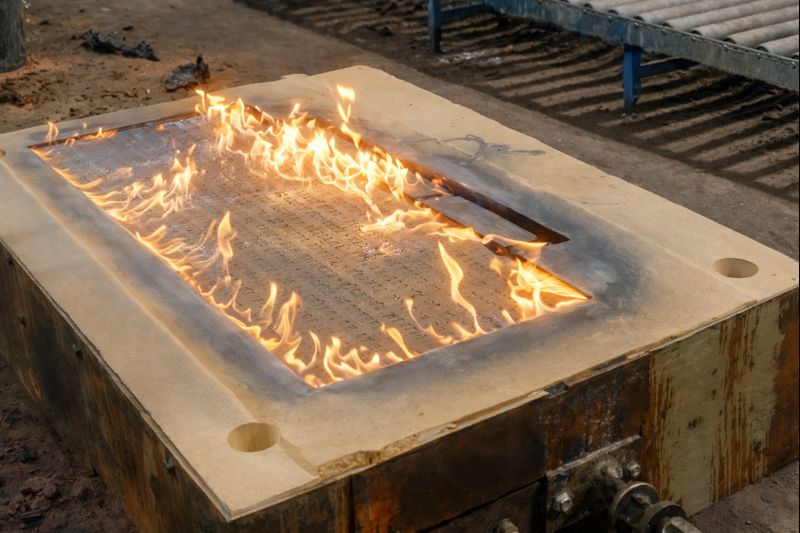
The pattern is placed into a flask and surrounded by specially formulated sand to create the mould.
What is Alpha Set Moulding?
At Fowler & Holden, we use alpha set moulding – a no-bake process where chemical binders harden the sand. This allows:
- Excellent dimensional stability.
- Smooth surface finish.
- High accuracy for complex parts.
- Reduced defects in large or high-spec castings.
After the mould sets, the pattern is removed, and the mould is assembled with cores and gating systems.
Pouring the Metal
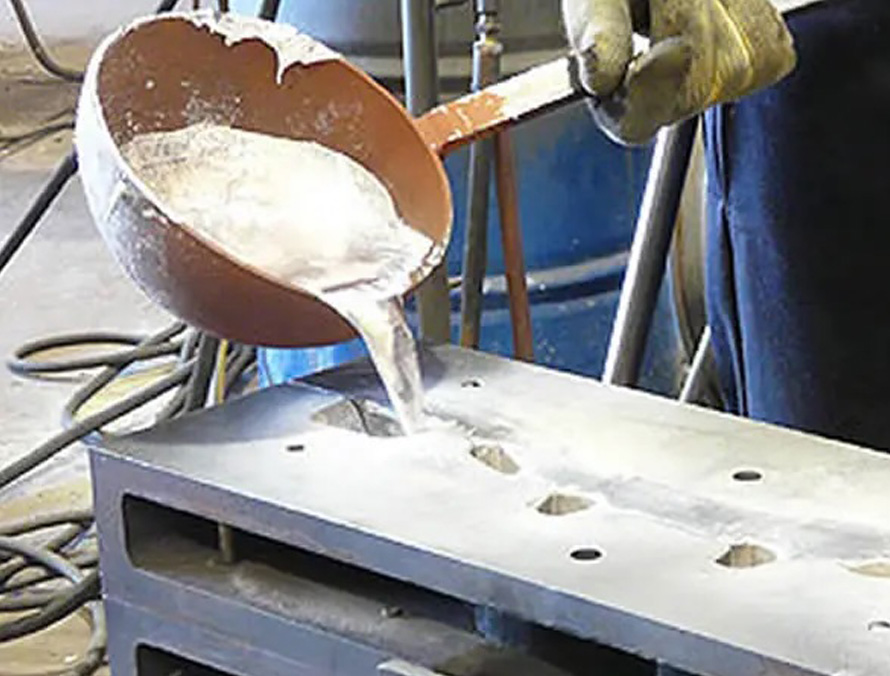
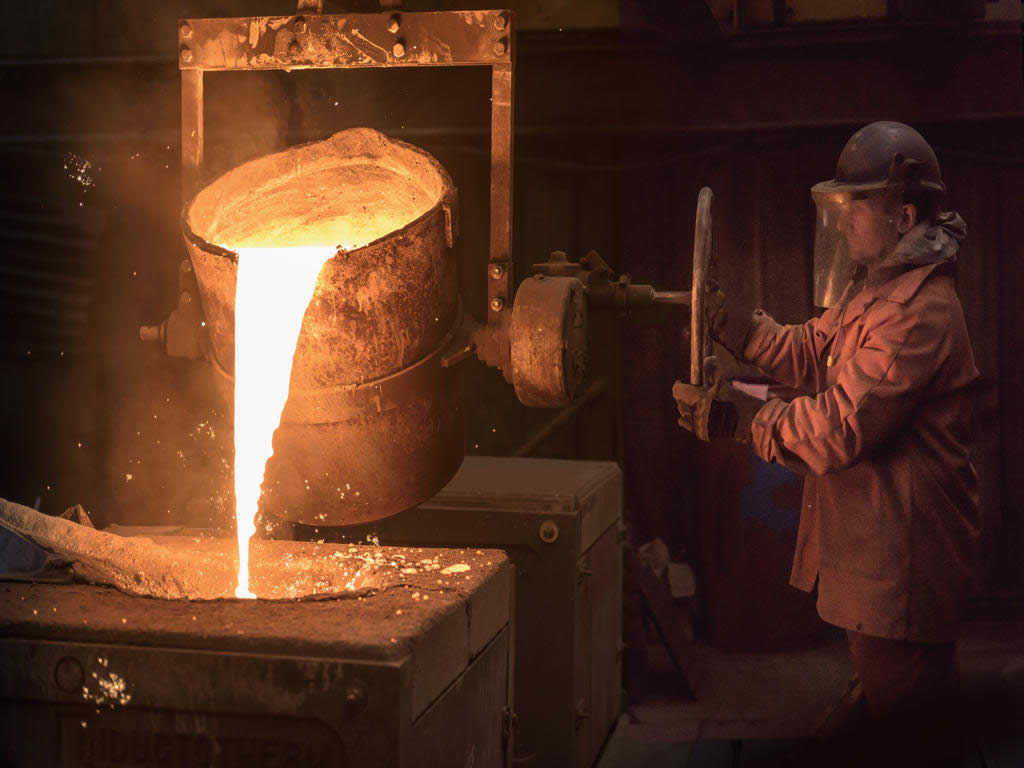
The selected iron is melted in a furnace and poured at over 1,400°C into the mould cavity. Once cooled, the sand is removed, and the raw casting is revealed.
Typical Tolerances
Thanks to alpha set moulding and pattern precision, we routinely achieve:
- ±1.0mm for small features.
- ±2.5mm on large dimensions.
- Machining allowances of 2-5mm depending on finish.
Tighter tolerances can be met with additional machining.
Step 3 – Finishing and Inspection
After the casting is removed from the mould and cooled, it undergoes cleaning, fettling, and quality inspection.
Post-Casting Finishing
- Removal of risers, runners, and flash.
- Shot blasting or grinding for a clean finish.
- Dimensional verification of key features.
Castings can be supplied:
- As-cast (no machining).
- Rough-machined.
- Fully machined to drawing spec.
Machining Options
Fowler & Holden operates a full in-house machine shop, so we can:
- Bore, face, and mill parts.
- Thread and tap holes.
- Deliver parts ready for fitment.
This eliminates third-party delays and allows full control over tolerances and finish.
Why Work With Fowler & Holden?
We’ve refined the iron casting process UK manufacturers rely on. Here’s what makes our service different:
- In-house pattern shop with legacy and CAD-based workflows
- Alpha set moulding for repeatable precision.
- Certified materials with full traceability.
- UK-based machining and fast delivery.
- Support from concept to completion.
Whether you need 1 part or 1,000, we handle every step – and every tolerance.
FAQs
What are the main steps in iron casting?
Pattern making, moulding, metal pouring, cooling, fettling, inspection, and optional machining.
How is the pattern made?
We use CNC or manual techniques with wood, resin, or metal depending on volume and detail.
What types of moulds are used?
We use alpha set sand moulding for high-precision, repeatable results.
Can I request specific surface finishes?
Yes – we offer as-cast, blasted, machined, or coated finishes depending on your requirements.
How accurate is the final casting?
We typically deliver castings to ±1-2.5mm accuracy and machine to ±0.05mm.
Ready to request a quote or start a new project?
Contact us
Call: +44 (0)1472 355 316
Email: enquiries@fowlerandholden.co.uk