From Raw Casting to Precision-Engineered Component
Casting creates the foundation of a component. Machining refines it to specification.
Many industrial parts require more than an as-cast finish. They need precise bores, flat faces, threaded holes and tight tolerances to function correctly within assemblies. That is where machining becomes critical.
At Fowler & Holden, we provide fully integrated casting and machining services. As a machined iron castings UK supplier, we deliver components that are ready for installation, not further processing.
This guide explains when machining is required, what tolerances can be achieved and how we handle the process in-house.
Why Machining Is Required for Iron Castings
Iron casting allows complex shapes to be formed efficiently.
However, casting alone cannot always achieve:
- Tight dimensional tolerances.
- Smooth bearing surfaces.
- Accurate alignment between features.
- Threaded or tapped holes.
- Precision mating faces.
Machining ensures the casting performs exactly as required within the finished assembly.
Typical components requiring machining include:
- Bearing housings.
- Pump casings.
- Structural brackets.
- Infrastructure components.
- Drainage systems with interface points.
Our Machining Capabilities
Fowler & Holden operates a dedicated in-house machine shop, allowing us to control quality, lead times and consistency.
Our capabilities include:
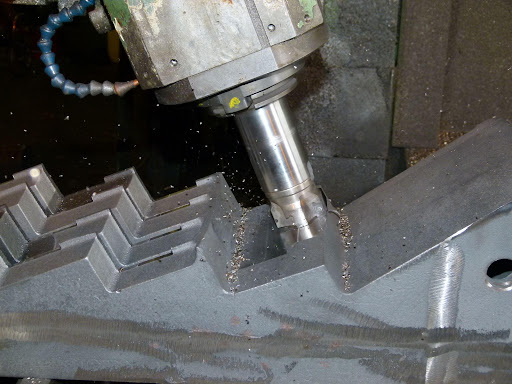
- CNC milling.
- CNC turning.
- Bore machining.
- Face machining.
- Drilling and tapping.
- Surface preparation.
- Component finishing.
By combining foundry and machining under one roof, we eliminate the need for subcontracted operations. This reduces delays and improves quality control.
When Machining Is Essential
Machining is required when:
- Parts must fit into tight assemblies.
- Bearings require precision alignment.
- Flatness is critical for sealing.
- Threads are needed for fastening.
- Surface finishes must meet specification.
For example, a drainage casting may only require limited finishing, while a bearing housing may require multiple precision-machined faces and bores.
We advise clients at quotation stage on whether machining is necessary and where it adds value.
Tight Tolerance Machining Explained
Casting tolerances are typically measured in millimetres. Machining allows refinement to much tighter standards.
Depending on the feature and size, we can achieve:
- Bore tolerances within hundredths of a millimetre.
- Precise flatness for mating surfaces.
- Accurate concentricity for rotating components.
These tolerances are essential for components operating under load, vibration or rotational stress.
Surface Finishes and Post-Casting Refinement
Beyond dimensional accuracy, machining improves surface finish.
Common finishing processes include:
- Shot blasting before machining.
- Precision face finishing.
- Thread cutting.
- Deburring and cleaning.
- Preparation for coating or painting.
The result is a component that is fully prepared for installation.
In-House Machining vs Subcontracting
Some foundries subcontract machining to third-party workshops. This often introduces:
- Longer lead times.
- Reduced quality control.
- Communication delays.
- Increased transport costs.
At Fowler & Holden, machining is fully integrated into our production process. This means:
- Faster turnaround.
- Direct communication between casting and machining teams.
- Better traceability.
- Reduced risk of dimensional mismatch.
The result is greater reliability for our clients.
Handling Large and Heavy Castings
Industrial projects often involve substantial cast components.
We are equipped to handle:
- Large structural castings.
- Heavy-duty brackets.
- Infrastructure components.
- Marine and transport castings.
Our machining setup accommodates substantial parts while maintaining precision.
CNC Cast Part Supplier for UK Industry
As a UK-based CNC cast part supplier, we support:
- Infrastructure contractors.
- Marine engineering projects.
- Rail developments.
- Renewable energy installations.
- General industrial manufacturing.
Our integrated approach ensures castings are produced, machined and delivered within agreed project timelines.
FAQs
1. Do you machine iron castings in-house?
Yes. All machining is carried out in-house, ensuring full quality control and reduced lead times.
2. What tolerances can you achieve?
We can achieve tight tolerances depending on the feature, often within hundredths of a millimetre for precision bores and faces.
3. What machining services do you offer?
We provide CNC milling, turning, bore machining, face machining, drilling, tapping and finishing.
4. Can I get parts fully finished?
Yes. We deliver fully machined and prepared components ready for installation.
5. Do you handle large castings?
Yes. Our facility can machine large and heavy iron castings used in infrastructure and industrial applications.
Download Our Iron Casting RFQ Checklist
If your casting requires machining, ensure your RFQ includes all tolerance and finish requirements.
Download our Checklist To prepare your enquiry properly.
Work With a UK Supplier That Casts and Machines Under One Roof
When precision matters, integrated casting and machining makes the difference.
Contact us
Call: +44 (0)1472 355 316
Email: enquiries@fowlerandholden.co.uk